
Master Prompt for n8n Workflow JSON Architecture
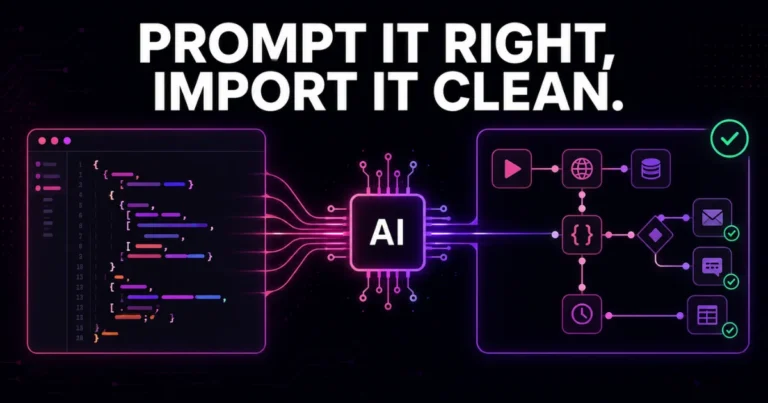
Asking an AI to “write me an n8n workflow for X” usually produces something that looks right at a glance and then fails the moment you try to import it. Missing typeVersion fields, malformed connections objects, node types that don’t actually exist, or credentials referenced as if they’re already configured in your instance — these are the recurring failure points that make AI-generated n8n JSON frustrating rather than genuinely time-saving.
The underlying issue is that n8n’s workflow JSON format has a specific, somewhat unforgiving structure, and most AI models have seen plenty of generic JSON in training but comparatively little of n8n’s exact schema conventions. A well-engineered prompt closes that gap by explicitly teaching the AI the structure it needs to follow, rather than hoping it infers the format correctly from a vague request.
In this guide, we’ll build a master prompt for generating valid n8n workflow JSON — the same approach our team at Dynamic Tech World uses when prototyping automation logic with AI before refining it inside the actual n8n editor.
Table of Contents
Why n8n JSON Trips Up AI Models More Than Typical JSON Tasks
A few structural realities of n8n’s format explain why generic prompting produces broken workflows:
- Every node needs a typeVersion matching a real, existing version of that node type — guessing a plausible-looking number often produces an import error or silent misbehavior
- The connections object is keyed by node name, not node ID, and its structure (arrays of arrays, grouped by output index) is unusual enough that AI models frequently get the nesting wrong
- Node type strings must match exactly (n8n-nodes-base.httpRequest, not n8n-http-request or other plausible-sounding variants)
- Credentials in exported JSON are references, not live connections — a generated workflow can’t actually authenticate to anything until you manually attach real credentials inside the editor
None of these are things a generic “write me JSON for an automation” prompt accounts for, which is exactly why the workflows produced from vague prompts import with errors or silently fail at runtime.
The Master Prompt Template
Why Each Rule Exists
Rule 1 (top-level structure): Missing required top-level keys is one of the most common reasons an AI-generated workflow fails to import cleanly. Explicitly listing them removes the guesswork.
Rule 2 (node object structure): This is the core of what most generic prompts get wrong — AI models often omit typeVersion entirely or invent a plausible-sounding node type string that doesn’t correspond to a real n8n node. Being explicit about the required fields, and asking the AI to flag uncertainty rather than guess confidently, turns a silent failure into a visible one you can fix before importing.
Rule 3 (connections structure): This is genuinely the most error-prone part of n8n JSON for AI to generate correctly, since the nested array-of-arrays structure, keyed by node name rather than ID, isn’t an intuitive format. Spelling out the exact shape expected reduces malformed connections significantly.
Rule 4 (credentials handling): This rule exists specifically to stop the AI from inventing fake-looking API keys or credential IDs that look real but do nothing — a surprisingly common failure mode when a model tries to be “complete” rather than honest about what it can’t know. Real credentials always need to be attached manually inside your own n8n instance for security reasons; no legitimate workflow JSON should ever contain live secrets.
Rule 5 (conditional logic branches): IF and Switch nodes are where the connections structure gets genuinely more complex, since multiple output branches each need their own correctly indexed connection array. This is a common source of workflows that import but silently misroute logic.
Rule 6 (AI/LangChain sub-nodes): If your workflow includes an AI Agent, its connected components (language model, tools, memory) use distinct connection type keys rather than the standard "main" type used for regular node-to-node data flow. This is a newer and less well-represented pattern in most AI models’ training data, so it’s worth flagging explicitly.
Rule 7 (explain uncertainty): This is arguably the most valuable rule in the whole prompt. An AI that confidently states a typeVersion number without flagging any doubt gives you false confidence in a detail that might be wrong. Asking it to explicitly separate “here’s what I’m confident about” from “here’s what you should verify” turns the output into something you can actually trust incrementally, rather than an all-or-nothing black box.
Example: Filling In the Workflow Description
A well-prompted response to this would produce four connected nodes (Webhook → Set/Edit Fields → Google Sheets → Slack), each with correctly structured parameters, a properly nested connections object linking them in sequence, placeholder credential references for Google Sheets and Slack with a clear note to replace them, and an explanation flagging which typeVersion numbers it’s most confident about versus which ones are worth double-checking against your actual n8n instance version.
Validating the Output Before Importing
Even with a well-structured prompt, treat the generated JSON as a strong draft rather than something to import blindly into a production instance. A few practical validation steps:
- Import into a test/staging workflow first, not directly into a live, active automation
- Check the n8n editor’s error indicators immediately after import — invalid node types or malformed connections typically surface as visible errors on the canvas rather than failing silently
- Manually verify every typeVersion against what’s actually available in your n8n instance, especially for less common nodes, since AI training data can lag behind the latest node versions
- Never trust placeholder credentials as real — always create and attach your own credentials inside the n8n UI, never paste API keys directly into JSON you’re sharing or generating with AI
Common Mistakes to Avoid
- Accepting the JSON without a staging import test. Even well-prompted AI output can contain a subtly wrong typeVersion or connection structure that only surfaces on import.
- Asking for the workflow without describing the trigger and destination clearly. Vague workflow descriptions produce vague, generic node choices — be as specific about the actual business logic as you’d be describing it to a human developer.
- Forgetting Rule 6 for AI Agent workflows. This is the single most common structural mistake in AI-generated n8n JSON that includes LangChain-based nodes, since the sub-node connection types are easy to overlook.
- Pasting real API keys into a prompt to “help” the AI generate accurate credentials. Never do this — credentials should always be attached manually inside your own n8n instance after import, not embedded in generated JSON.
- Ignoring the AI’s own flagged uncertainty. If the explanation notes it’s unsure about a specific typeVersion or node type, that’s precisely the detail worth checking first.
Final Thoughts - Master Prompt for n8n Workflow JSON Architecture
Generating valid n8n workflow JSON with AI is genuinely useful for prototyping automation logic quickly, but it depends entirely on how precisely the prompt teaches the AI n8n’s actual schema conventions — the node structure, the connections format, credential handling, and the special case of AI sub-node connections. A prompt built around these specific rules consistently produces workflows that import cleanly and require only minor adjustment, rather than JSON that looks plausible but breaks the moment you try to use it.
Want custom n8n workflows designed, built, and properly tested for your business — not just prototyped? Talk to Dynamic Tech World about your automation needs, or explore our portfolio for examples of past automation projects.
Frequently Asked Questions
Why does AI-generated n8n JSON often fail to import correctly?
The most common causes are missing or incorrect typeVersion fields, malformed connections objects (which use an unusual nested array structure keyed by node name), and invented node type strings that don’t correspond to real n8n nodes. A well-structured prompt that explicitly defines these requirements significantly reduces these errors.
Can AI-generated n8n JSON include working API credentials?
No, and it shouldn’t attempt to. Legitimate n8n workflow JSON should only reference placeholder credential names, never actual API keys or tokens. Real credentials must always be created and attached manually inside your own n8n instance for security reasons.
What’s different about connecting AI Agent nodes in n8n JSON?
AI Agent and LangChain-based nodes use distinct connection type keys (like “ai_languageModel”, “ai_tool”, “ai_memory”) instead of the standard “main” connection type used for regular data flow between nodes, which is a detail many AI models overlook without explicit prompting.
Should I import AI-generated n8n JSON directly into a live workflow?
No. Always import into a test or staging workflow first, check for any errors the n8n editor surfaces, and verify node types and typeVersion numbers before considering it for a live, active automation.
How do I know if the typeVersion the AI generated is correct?
Cross-check it against your actual n8n instance by adding the same node type manually in the editor and comparing versions, or use a schema validation tool designed for n8n workflows. A well-prompted AI should also flag which typeVersion numbers it’s less confident about.
Is this prompt useful for beginners who don’t know n8n’s node types well?
It’s helpful for prototyping and learning the general structure, but beginners should still expect to review and adjust the generated workflow inside the actual n8n editor rather than treating AI output as a finished, production-ready automation.

Abhay Pathak
Founder, Dynamic Tech WorldAs a full-stack web developer and AI orchestration specialist based in New Delhi, I help creators and agencies scale their digital assets through automated systems, high-speed development, and advanced prompt engineering.
Launch Your Site
Claim up to 20% OFF Premium Web Hosting + a FREE Domain. Fast & Secure.
Claim DiscountJoin the VIP Club
Get free Elementor Pro updates, premium AI prompts, and daily tech hacks directly on our Telegram.
Join TelegramWork With Us
Need a high-converting website, custom AI workflow, or want to advertise your brand to our global audience?
Contact Agency